Installing Docker Desktop on my Ubuntu 24.04 — A Product Manager’s Learning Journal

As a Product Manager, I hear the word Docker all the time.

“Let’s containerize it.”
“It works on Docker.”
“Just run it locally.”

I nodded. I moved on. I never actually touched it.

This post documents how I installed Docker Desktop on Ubuntu 24.04, not to become an engineer, but to stop being a Product Manager who doesn’t really understand what Docker is.

This is a learning journal for absolute beginners, especially Product Managers who want context, not command-line mastery.

Why a Product Manager Should Install Docker (At Least Once)

I’m not trying to write production code.

I am trying to:

  • Follow technical conversations without guessing

  • Understand developer constraints

  • Ask better product questions


Installing Docker locally was the smallest, lowest-risk step I could take

Why Startups Should Pay Attention

The uncomfortable truth is this:

AI success isn’t about model quality anymore.
It’s about the infrastructure around the model.

Qwen’s rise highlights four advantages only giants possess:

1. Distribution Advantage

Startups need to market their way to users.
Alibaba just placed Qwen in apps used daily by millions.

2. Capital Advantage

Startups rely on subscription revenue to survive.
Alibaba can offer free access indefinitely.

3. Data Advantage

Su Lian Jye said it well:
“More users mean more feedback — enabling faster fine-tuning.”

This is a flywheel startups can’t replicate without scale.

4. Ecosystem Advantage

AI becomes exponentially more valuable when tied to payments, logistics, local search, business tools, and marketplaces.

Startups build features.
Giants build ecosystems.

My Setup

For clarity and reproducibility:


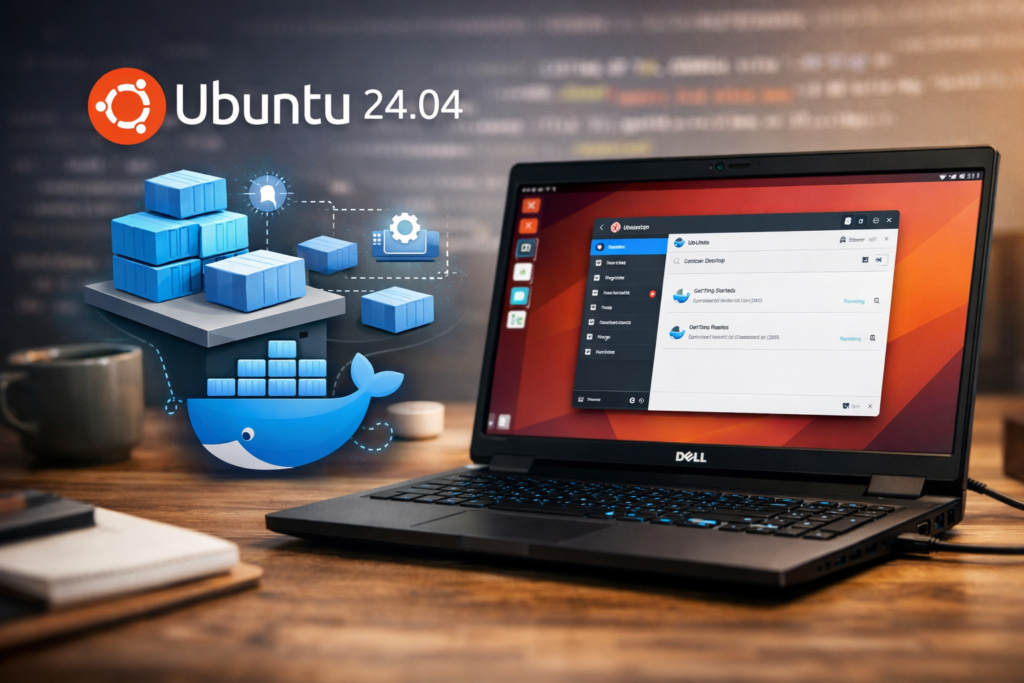
  • Laptop: Dell G15

  • Operating System: Ubuntu 24.04 (Noble)

  • RAM: 32 GB

  • Graphic Card: NVIDIA GeForce RTX™ 3060 Laptop GPU

  • Goal: Install Docker Desktop and verify it runs locally

Steps I followed to Installed Docker Desktop (GUI)

Step 1: Update and Clean the Base System

Before installing Docker, I updated my system and ensured no legacy Docker components were installed.

sudo apt update && sudo apt upgrade -y
sudo apt remove -y docker docker-engine docker.io containerd runc

APT reported that Docker wasn’t previously installed — which confirmed a clean starting point.


Step 2: Install Required Dependencies

Docker relies on several helper packages for secure downloads and repository management.

sudo apt install -y ca-certificates curl gnupg apt-transport-https software-properties-common

Most were already present, but explicitly installing them avoided surprises later.


Step 3: Add Docker’s Official APT Repository (Ubuntu 24.04)

This was the first moment Docker stopped feeling “magical” and started feeling infrastructure-like.

Create a secure keyring directory

 sudo install -m 0755 -d /etc/apt/keyrings

Download Docker’s GPG key

sudo curl -fsSL https://download.docker.com/linux/ubuntu/gpg -o /etc/apt/keyrings/docker.asc
sudo chmod a+r /etc/apt/keyrings/docker.asc

Add the Docker repository for Ubuntu Noble

echo \
https://download.docker.com/linux/ubuntu \
$(. /etc/os-release && echo "$VERSION_CODENAME") stable" \
  | sudo tee /etc/apt/sources.list.d/docker.list > /dev/null
  "deb [arch=$(dpkg --print-architecture) signed-by=/etc/apt/keyrings/docker.asc] \
 Then refresh package lists:
 
sudo apt update

PM insight: This step alone taught me how seriously Linux treats software trust and verification.


Step 4: Install Docker Engine and CLI

Docker Desktop relies on Docker Engine under the hood. 

sudo apt install -y docker-ce docker-ce-cli containerd.io

In my case, these were already installed or upgraded to the latest versions.


Step 5: Install Docker Desktop on Ubuntu

To make Docker more approachable, I chose Docker Desktop instead of working only from the terminal.

I downloaded the official .deb installer (amd64) and ran: 

cd ~/Downloads
sudo apt install ./docker-desktop-amd64.deb

Docker Desktop:

  • Installed cleanly

  • Enabled required system services

  • Updated user-level systemd configurations automatically

This mattered to me. Visibility beats purity when you’re learning.


Step 6: Start and Verify Docker Desktop

You can launch Docker Desktop either via:

  • Activities → Docker Desktop, or

  • Terminal: 

systemctl --user start docker-desktop

(Optional) Enable startup on login: 

systemctl --user enable docker-desktop

Verify Docker is working: 

docker context ls
docker version

Seeing Docker run locally was the moment abstraction turned into understanding.


What I Learned Installing Docker as a Product Manager

  1. Docker isn’t magic
    It’s packaged infrastructure with clear dependencies.

  2. Hands-on beats theoretical understanding
    Installation alone clarified months of vague conversations.

  3. You don’t need depth to gain empathy
    You just need first-hand exposure.

This Is Just the Beginning

I still wouldn’t call myself “good at Docker.”

But now:

  • I can follow engineering discussions

  • I understand where my gaps are

  • I know what questions actually matter

Next steps for me:

  • Run a simple container

  • Break something safely

  • Learn how applications really ship

If you’re a Product Manager who keeps hearing “Docker” in meetings — try installing it once.

Not to become technical.
Just to stop being clueless.

🚀 If you found this useful, don’t forget to share it with fellow product enthusiasts!